
As part of the Connecticut Urgent Maternal Warning Signs Bracelet Initiative, hospitals are raising awareness about signs that a newborn needs urgent medical attention, when and where to seek care, and recommended safe sleep practices.
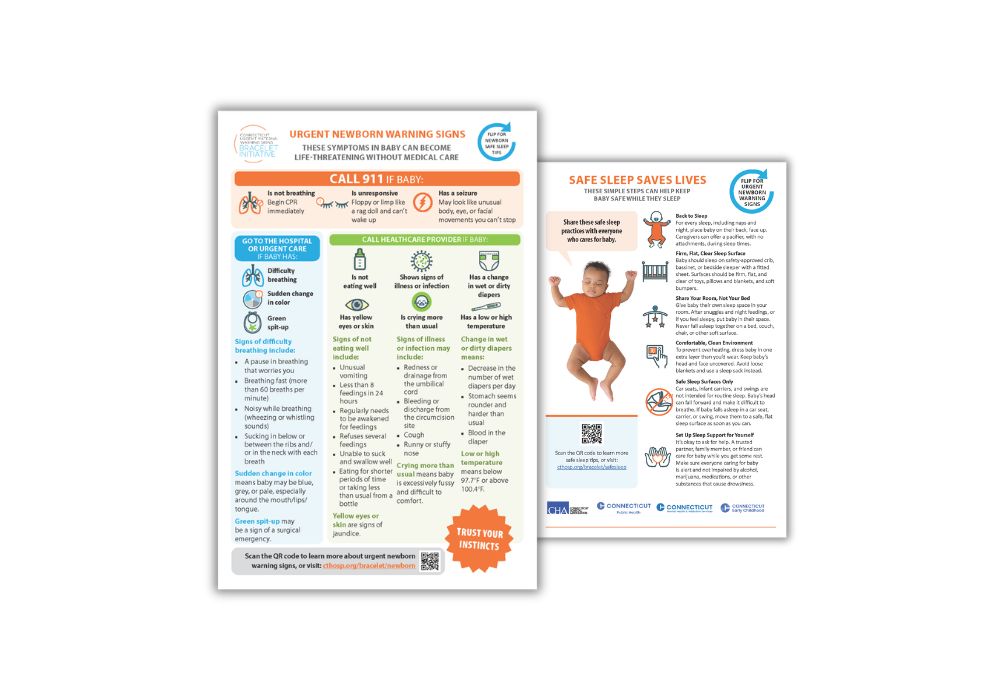

As part of the Connecticut Urgent Maternal Warning Signs Bracelet Initiative, hospitals are raising awareness about signs that a newborn needs urgent medical attention, when and where to seek care, and recommended safe sleep practices.

Begin CPR immediately

Floppy or limp like a rag doll and can’t wake up

May look like unusual body, eye, or facial movements you can’t stop

Blue, grey, or pale, especially around the mouth/lips/tongue

A pause in breathing that worries you · Breathing fast (more than 60 breaths per minute) · Noisy while breathing (wheezing or whistling sounds) · Sucking in below or between the ribs and/ or in the neck with each breath

May be a sign of a surgical emergency

Below 97.7°F or above 100.4°F

May be signs of jaundice

Excessively fussy and difficult to comfort

Unusual vomiting · Less than 8 feedings in 24 hours · Regularly needs to be awakened for feedings · Refuses several feedings · Unable to suck and swallow well · Eating for shorter periods of time or taking less than usual from a bottle

Decrease in the number of wet diapers per day · Stomach seems rounder and harder than usual · Blood in the diaper

Redness or drainage from the umbilical cord· Bleeding or discharge from the circumcision site · Cough · Runny or stuffy nose
This handout supports consistent education for parents and caregivers on signs that may indicate a newborn needs urgent medical attention, when and where to seek care, and recommended safe sleep practices.

For every sleep, including naps and night, place baby on their back, face up. Caregivers can offer a pacifier, with no attachments, during sleep times.

Baby should sleep on safety-approved crib, bassinet, or bedside sleeper with a fitted sheet. Surfaces should be firm, flat, and clear of toys, pillows and blankets, and soft bumpers.

Give baby their own sleep space in your room. After snuggles and night feedings, or if you feel sleepy, put baby in their space. Never fall asleep together on a bed, couch, chair, or other soft surface.

To prevent overheating, dress baby in one extra layer than you’d wear. Keep baby’s head and face uncovered. Avoid loose blankets and use a sleep sack instead.

Car seats, infant carriers, and swings are not intended for routine sleep. Baby’s head can fall forward and make it difficult to breathe. If baby falls asleep in a car seat, carrier, or swing, move them to a safe, flat sleep surface as soon as you can.

It’s okay to ask for help. A trusted partner, family member, or friend can care for baby while you get some rest. Make sure everyone caring for baby is alert and not impaired by alcohol, marijuana, medications, or other substances that cause drowsiness.