

Who We Are

The Connecticut Perinatal Quality Collaborative (CPQC), a CHA initiative, is a state network of teams dedicated to enhancing quality of care for mothers and newborns across the continuum. CPQC members identify areas of improvement in healthcare processes and use the best available methods to implement remedies as quickly as possible. The coalition comprises physicians, nurses, lactation consultants, additional maternal/infant healthcare providers, and state agency/community stakeholders. Through its work, CPQC facilitates cooperation among hospitals and healthcare providers, supports evidence-based maternal and newborn care practices, shares educational and training resources, and gathers critical data.

CPQC supports high-quality maternal and newborn care by:

  • Working collaboratively with healthcare providers
  • Supporting the best care
  • Sharing resources
  • Gathering data that helps improve care
What is a Perinatal Quality Collaborative (PQC)?

A Focus on Perinatal Mental Health Conditions

Perinatal mental health conditions — including depression, anxiety, and bipolar disorder — are among the most common complications of pregnancy and the postpartum period, affecting approximately one in five individuals. Public awareness and provider training initiatives have been expanding in Connecticut and across the nation, yet roughly half of cases go undiagnosed and untreated.
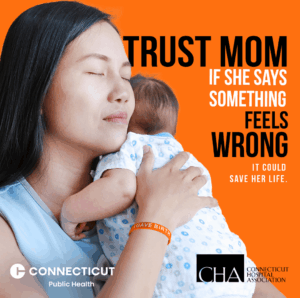
The CPQC supports statewide efforts by birthing hospitals and partners to advance the mental health of pregnant and postpartum populations. The CPQC and CHA have led on launching the Connecticut Urgent Maternal Warnings Signs Bracelet Initiative and AIM Perinatal Mental Health Conditions Patient Safety Bundle with birthing hospitals and partnering with communities to advance maternal mental health across the continuum of care. The CPQC has worked to develop a powerful opportunity to advance maternal mental health through the Bracelet Initiative. By prompting both families and healthcare providers to recognize critical symptoms early, including thoughts of self-harm, the Bracelet Initiative serves as a vital safety net that strengthens our broader efforts to protect mental health in the postpartum period.

A critical component of the AIM Perinatal Mental Health Conditions Patient Safety Bundle implementation work includes providing advanced clinical training on the screening and assessment of perinatal mental health conditions including suicidality and bipolar disorders. To support healthcare teams in this vital effort, the CPQC and CHA also work to offer education in these areas.

Learn About AIM
Printable Patient Handout

Maternal Mental Health and Substance Use Support

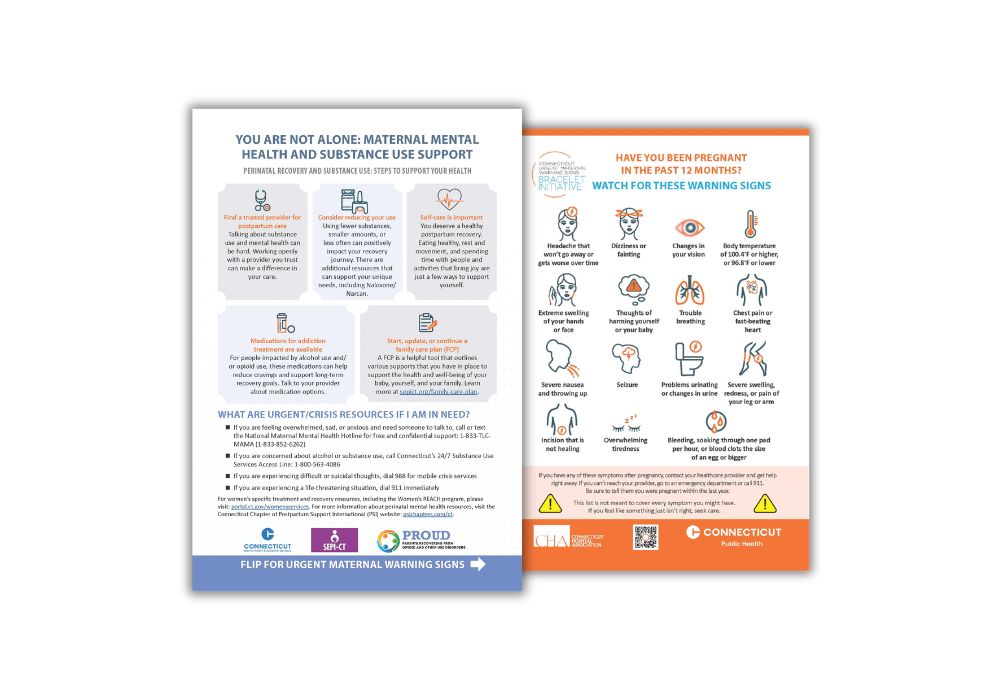
This two-sided handout is a printable handout, designed as a quick reference for pregnant and postpartum patients. As part of Parents Recovering From Opioid and Other Use Disorders (PROUD), one side includes maternal mental health and substance use supports and services, and the other features urgent maternal warning signs via the Bracelet Initiative.

View and Download

Perinatal Mental Health Resources

It's Worth It

March of Dimes

Why at least 39 weeks is best for your baby:

  • Lungs and Liver

    Babies born too early may have breathing problems and jaundice after birth

  • Eyes and Ears

    Less likely to have vision and hearing problems after birth

  • Weight

    Babies born at a healthy weight have an easier time staying warm than babies born too small

  • Suck and Swallow

    Babies born early sometimes can’t stay awake long enough to eat

Learn More

The State of Connecticut, through the Office of Early Childhood, is offering Sparkler — a mobile app — to all parents with young children and to programs serving those families.

Connecticut is the first state in the nation to offer families with children up to 5 years old comprehensive mobile developmental screening, promotion, and linkage to supports.

Download Sparkler Mobile App

Meeting Materials Archive

  • Looking at Maternal and Infant Health Through the Lens of Health Equity presentation by Kenn Harris (linked here) 
  • Re-Engineering Post-Partum Care of the Mother/Infant Dyad presentation by Dr. Leslie Sude and Elizabeth Znamierowski (linked here)
  • Connecticut Department of Public Health’s (DPH) Maternal Mortality Review Committee
    • Connecticut Maternal Mortality Review Committee (MMRC) presentation by Lisa Budris (linked here)
    • DPH’s Maternal Mortality Review website (linked here)
    • MMRC Recommendations Report (linked here)
  • Connecticut Office of the Child Advocate’s Child Fatality Review Panel
    • Child Fatality Review Panel presentation by Brendan Burke (linked here)
    • The Infant Toddler Fatality Report, July 2023 (linked here)
  • ACCESS Mental Health for Moms
    • ACCESS Mental Health for Moms presentation by Dr. Ariadna Forray (linked here)
    • ACCESS Mental Health for Moms website (linked here)
  • Connecticut Department of Mental Health and Addiction Services (DMHAS)
    • Supporting Women in the Perinatal Period presentation by Shelly Nolan (linked here)
    • CT DMHAS Women’s Treatment Services Brochure (linked here) 
  • AIM Updates from Dr. Kathleen Zacherl and Lisa Douglas (linked here)

  • Parents Recovering from Opioid and Other Use Disorders (PROUD)
    • PROUD Summer Series Flyer (linked here)
    • Parents Recovering from Opioid and Other Use Disorders (PROUD) flyer (linked here)
    • Parents Recovering from Opioid and Other Use Disorders (PROUD) Spanish flyer (linked here)
    • Parents Recovering from Opioid and Other Use Disorders (PROUD) trifold brochure (linked here)
  • Women’s REACH Program Brochure (linked here)
  • ACCESS Mental Health for Moms
    • ACCESS Mental Health for Moms Perinatal Mental Health and Substance Use Toolkit (linked here)
    • ACCESS Mental Health for Moms Brochure (linked here)
  • Secure Storage Information Sheet (linked here)
  • Substance Exposed Pregnancy Initiative of Connecticut (SEPI-CT) brochure (linked here)
  • SEPI-CT Informational Videos flyer (linked here)
  • Treatment Services for Women with Substance Use Disorders in Connecticut brochure (linked here)
  • Naloxone is Safe For Everyone flyer (linked here)

  • It’s Worth It
    • It’s Worth It – Breastfeeding (linked here)
    • It’s Worth It – Breastfeeding Spanish (linked here)
    • It’s Worth It – Make A Plan (linked here)
    • It’s Worth It – Skin to Skin (linked here)
    • It’s Worth It – Skin to Skin Spanish (linked here)
  • Learn the Signs, Act Early (linked here)
  • Medication – A Path to Recovery (linked here)
  • Postpartum Support International (linked here)
  • Sparkler App (linked here)
  • Baby Bonds
    • Baby Bonds flyer – multiple languages (linked here)
    • Baby Bonds Ambassadors sign-up (linked here)


Contact CPQC

The contents of this website are for educational and informational purposes only. This information is not medical advice, and is not intended to be a substitute for professional medical advice, diagnosis, or treatment. Always seek the advice of a physician or other qualified health provider with any questions that you may have regarding a medical condition.

Name(Required)
Email(Required)