
WEEKLY UPDATE: 05/21/26
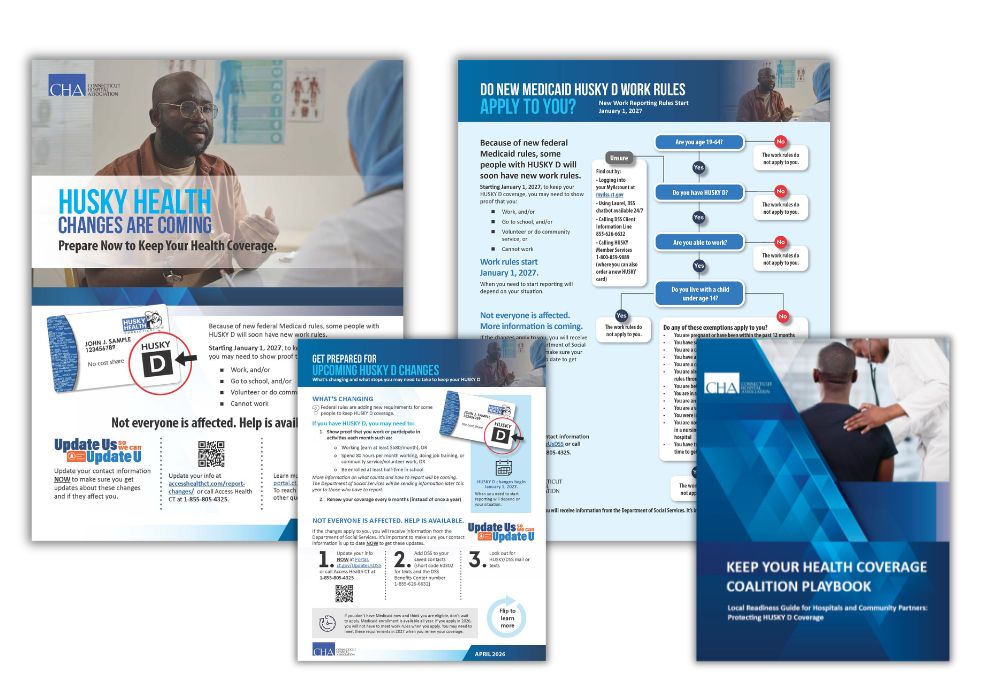
The Connecticut Hospital Association (CHA), in consultation with the Department of Social Services (DSS), has released new informational materials to help hospitals, community-based organizations (CBO), and healthcare providers prepare to support and communicate to patients about the federal Medicaid eligibility changes and new work rules taking effect January 1, 2027. These changes — resulting from H.R. 1, the One Big Beautiful Bill Act (OBBBA) — are expected to create new risks for coverage loss and disruption in care, especially for many, but not all, individual adults enrolled in HUSKY D.
HUSKY Health is Connecticut’s public health coverage program, encompassing Medicaid and the Children’s Health Insurance Program (CHIP). HUSKY D covers low-income adults without dependent children. According to the latest data from DSS, an estimated 110,000 HUSKY D enrollees are at risk of coverage loss, accounting for about 35% of the total distinct HUSKY D population (approximately 316,000 members as of February 2026).
Messaging Starter Kit Materials
The HUSKY D Messaging Starter Kit, linked here, includes provider-facing guides for staff education and patient communications, as well as ready-to-use, printable patient-facing flyers and posters for distribution and display.
The provider-facing materials include a detailed overview of the anticipated impact of Medicaid eligibility changes, messaging templates, talking points, FAQs, and best practices:
The patient-facing outreach materials can be used by hospitals, healthcare providers, and CBOs immediately to inform and empower HUSKY D beneficiaries by raising awareness early and communicating proactively:
- HUSKY D Changes Fact Sheet
- HUSKY D Changes Poster
- Flowchart: Do HUSKY D Work Rules Apply to Me?
- HUSKY D Changes: SMS Awareness Messages 2026
The HUSKY D Messaging Starter Kit is intended to anchor information in the federal mandate, balance urgency with reassurance, improve clarity regarding who is affected, equip frontline staff with consistent language and knowledge, and broaden outreach through trusted channels.
Materials were developed with input from HUSKY D recipients, community health workers, Medicaid assisters, and DSS. Focus groups were facilitated in partnership with the Community Action Agency of New Haven, Connecticut Health Foundation, Hartford HealthCare, Hispanic Health Council, Ledge Light Health District, Ministerial Health Fellowship, and Health Equity Solutions (focus group moderator).
Keep Your Health Coverage Coalition Playbook
CHA has also released the Keep Your Health Coverage Coalition Playbook, a guide designed to give hospitals and community partners a practical starting structure for organizing local readiness work, including the formation and coordination of local coalitions.
As DSS leads on administering the HUSKY Health program and communicating about upcoming changes, local coalitions can support the state’s goal of protecting coverage by helping residents understand new requirements, reducing avoidable barriers to continued enrollment, connecting residents to trusted local supports, and elevating policy barriers and recurring operational issues that may require clarification or state attention.
The HUSKY D Messaging Starter Kit and the Keep Your Health Coverage Coalition Playbook are available here.
Core Components of HUSKY D Eligibility Changes
Key changes for adults on HUSKY D include:
- New work, education, and community service/volunteer rules for HUSKY D enrollees. Those enrolled in HUSKY D without an exemption to the new requirement will need to meet at least one of the following in order to maintain HUSKY D coverage: earn $580+/month, complete 80 hours/month of work, community service, volunteer work, training (or a combination), or be enrolled in school at least half-time
- Renewals required every six months (instead of 12)
- Retroactive HUSKY D coverage reduced to one month (from three)
- If not exempt from the work rules at initial application, eligibility includes a one-month lookback at work requirement compliance
- At renewal, there will be a six-month lookback to verify the individual met work/community engagement requirements or was exempt from requirements during at least one calendar month
The federal government is still finalizing many details. In the coming months, once federal guidance is issued, DSS is expected to lead the development and dissemination of future awareness and outreach materials.