WEEKLY UPDATE: 12/11/25
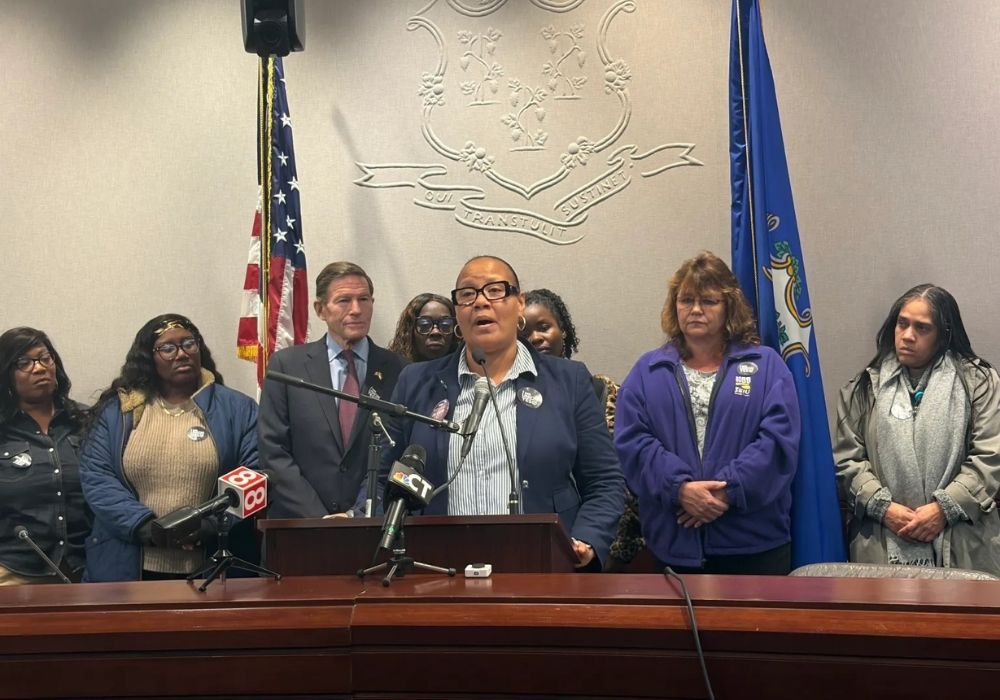
Connecticut nurses and policymakers joined U.S. Senator Richard Blumenthal (D-CT) at the state Capitol this week to sound the alarm on a proposed regulation that would restrict federal student loan borrowing for many seeking post-graduate training in healthcare professions, including advanced nursing degrees.
At the congressional news briefing on Monday, December 8, members of SEIU 1199 United Healthcare Workers East underscored that critical nursing roles, such as advanced practice registered nurses (APRN) who serve as primary care providers to patients throughout Connecticut, require post-graduate degrees.
“There are already enough roadblocks to becoming a nurse — financially, emotionally, and academically. Yet, instead of removing barriers, the government is adding new ones,” said Keisha Gartman, a registered nurse who accumulated $127,000 in loan debt to pursue her degree. “Taking on more debt isn’t a choice. It is only a path to advancing our careers so we can try to not just survive, but perhaps actually thrive.”
“What we should not be doing is strangling the resources available to people who want to pursue healthcare professions,” Sen. Blumenthal remarked at the press conference. “Nobody can expect nurses to enroll in these programs when the resources aren’t available to afford them.”
A 2020 report found that — without factoring in losses due to career change, relocation, or other reasons — Connecticut needs at least 3,000 registered nurses to enter the workforce every year to replace retiring nurses. This past year, out of the nearly 3,000 nursing applicants who were eligible to fill slots at Connecticut institutions, only about 2,600 enrolled, Blumenthal cited. The speakers warned that steeper expenses will deter aspiring nurses and ultimately deepen the workforce crisis.
During comments on the House floor last week, Congressman Joe Courtney (CT-02) decried the policy, calling it “out of touch,” “offensive,” and “an insult to the people who go through extensive training, testing, and certification before they are, again, allowed to practice their profession, the caring profession.”
Proposed Definition of Professional Degrees
H.R.1, the One Big Beautiful Bill Act, enacted sweeping reductions in federal student loan borrowing for all post-graduate degrees. A provision within the tax and spending law tasked the U.S. Department of Education with designating a set of degrees as “professional,” a definition that dictates the dollar amount a student may borrow. For students pursuing degrees not on the short list of so-called professional programs, federal loans are capped at half of the professional limit. The agency identified only 11 professional degrees that are eligible for higher lending caps, excluding valuable clinical and social services fields.
Effective July 2026, the policy caps loans for new borrowers at $50,000 per year for professional students ($200,000 aggregate limit) and only $20,500 for “graduate” students ($100,000 aggregate limit). This means, if the agency’s proposed definition is finalized, students pursuing master’s, doctorate, and other advanced degrees in, for example, nursing, physician assistant, physical therapy, public health, social work, rehabilitation services, and pediatric care — all deemed graduate programs — would be limited to borrowing $20,500 a year and up to $100,000 to complete the program.
The Connecticut Hospital Association (CHA) wrote a statement in response to the federal loan limits and proposed eligibility changes that reads in part, “In this moment, we must all focus on strengthening recruitment, expanding access to education, and supporting attainable pathways into healthcare careers — not creating barriers. Lowering loan caps for high-demand clinical fields undermines efforts to grow the workforce and shows a troubling lack of vision for the future of care.”
The Department of Education is expected to issue a Notice of Proposed Rulemaking in the coming weeks, opening a 30-day public comment period. CHA will continue to advocate for policies that grow and support the healthcare workforce.
Click here to read a statement from the American Organization for Nursing Leadership (AONL).
Click here to read a statement from the American Nurses Association.