WEEKLY UPDATE: 10/16/25

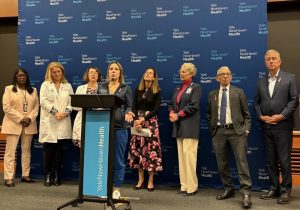
On Wednesday, October 15, nearly 100 local healthcare leaders and policy experts convened at the Connecticut Hospital Association (CHA) in Wallingford to examine the implications of H.R. 1, the One Big Beautiful Bill Act (OBBBA). The event marked the Connecticut Association of Healthcare Executives’ (CTAHE) next installment of its “Breakfast With Leaders Series,” bringing together voices from hospitals and health systems — including Yale New Haven Health President Pamela Sutton-Wallace and Hartford HealthCare Executive Vice President and Chief Operating Officer Bimal Patel — as well as insurance companies, policy experts, and federally qualified health centers (FQHCs) to explore how to navigate policy shifts, payment reforms, and operational challenges amid unprecedented uncertainty.
Moderator Brian Fisher, managing director of BRG, a global consulting firm, facilitated a panel discussion with CHA Senior Vice President of Policy Paul Kidwell, Community Health Center Association of Connecticut (CHC/ACT) Chief Strategy Officer Deb Polun, and Executive Director of the Connecticut Association of Health Plans and Robinson & Cole Co-Principal Susan Halpin. The three panelists represented the unique experiences and perspectives of Connecticut hospitals and health systems, FQHCs, and commercial insurance payers, examining the intersection of these sectors as they grapple with the repercussions of federal healthcare cuts. The panelists reflected on shared challenges, including how chronic Medicaid underpayment puts enormous pressure on negotiations between commercial payers and providers and inhibits efforts to meet the state’s healthcare cost growth benchmarking targets.
“We’re happy to sit around the table and talk about the cost of healthcare, but the state of Connecticut has to be at the table and be part of the conversation related to Medicaid,” Kidwell said.
The panelists also highlighted collective goals, including guiding patients through new Medicaid eligibility requirements and the looming expiration of Affordable Care Act (ACA) enhanced premium tax credits. They also agreed that building a robust workforce pipeline is integral to strengthening the state’s healthcare delivery system.
Sutton-Wallace, who was elected to the American Hospital Association (AHA) Board of Trustees in August and will begin her three-year term in January 2026, sat down for a fireside chat-style conversation with Fisher. Sutton-Wallace explained that for years, hospitals have tightened their belts in the face of significant economic headwinds, and recent federal policy changes are adding to the imperative to test new thinking and find new and innovative ways to deliver care.
“The cavalry isn’t coming. We are the cavalry,” she remarked, emphasizing that collaborative, statewide partnerships are key to developing patient-centered solutions.
Patel echoed this sentiment in his closing remarks.
“If the clouds are forming, it doesn’t mean it’s raining. So when that happens, what do you do? You get an umbrella, prepare for it, plan for it,” Patel said. “Agility was important. Now, agility has become critical.”
CTAHE represents professionals who manage the business affairs of healthcare organizations throughout the state. Organization membership comprises hospitals, health plans, health systems, independent physician associations, industry partners, and universities. CTAHE is a chapter of the American College of Healthcare Executives (ACHE), an international professional society of more than 40,000 healthcare executives who lead hospitals, healthcare systems, and other healthcare organizations.