WEEKLY UPDATE: 02/19/26
The Connecticut Hospital Association (CHA) applauds multiple state efforts to establish a Supplemental Graduate Student Loan Program within the Connecticut Higher Education Supplemental Loan Authority (CHESLA) to support access and affordability for Connecticut graduate students who may be impacted by recent cuts to federal student loan programs.
 Both the Higher Education and Employment Advancement Committee’s SB 8, An Act Supporting Graduate Students In The State, and the governor’s SB 85, An Act Authorizing And Adjusting Bonds Of The State And Establishing A Supplemental Graduate Student Loan Program, seek to institute this new program.
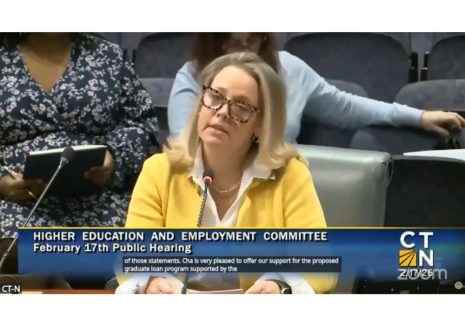
Testifying before the Higher Education and Employment Advancement Committee on Tuesday, February 17, in support of SB 8, CHA’s Allison Matthews-Wilson, senior director of workforce and clinical policy, said, “Graduate degrees are not optional when we are building state-of-the-art healthcare. For our trained teams, they are the minimum qualifications required to deliver safe, high-quality care. … Graduate degrees in nursing, physician assistants, social workers, and rehab specialists like OT, PT, and speech – these have always been gateway careers for aspiring caregivers of diverse backgrounds.”
Read CHA’s written testimony on SB 8 here.
CHA CEO Jennifer Jackson also released a statement applauding SB 85.
“We appreciate Governor Lamont’s proposal and the strong message it sends — that Connecticut stands with its healthcare workforce and believes in supporting opportunities for growth, advancement, and service to others,” said Jackson. “At a time when the need to nurture and grow the healthcare workforce has never been greater, we must focus on strengthening recruitment, expanding access to education, and supporting attainable pathways into high-demand fields, not creating new barriers.”
H.R. 1, the One Big Beautiful Bill Act (OBBBA), enacted a litany of provisions that make substantial changes to existing federal graduate student loan programs, including lower annual and aggregate loan limits and the complete elimination of the Grad PLUS loan program. As required by H.R. 1, the U.S. Department of Education has proposed a new list of “professional” programs that qualify for higher federal lending caps, which notably excludes essential graduate-level degrees in healthcare and related social service professions.
Together, these federal actions threaten to place graduate education out of reach for many, exacerbating persistent healthcare workforce shortages, particularly in rural and underserved communities. For professionals seeking advanced training, reduced borrowing limits could make programs financially unattainable, limiting entry into critical roles.
These legislative efforts serve as an important reminder that sustained, long-term solutions are essential to ensure Connecticut can continue to educate, recruit, and retain the compassionate, highly skilled healthcare workforce on which our communities depend.